


 By
By Introduction
As digital ecosystems grow increasingly complex, organizations are struggling to keep their systems connected, responsive, and scalable. Enterprises now operate across cloud platforms, edge devices, AI-driven analytics tools, and legacy infrastructure often resulting in fragmented communication and data silos. It becomes a potent remedy in this situation.
Qpibandee is designed to enable interoperability and adaptive system architecture in modern technological environments. It bridges disconnected systems, enhances performance efficiency, and allows organizations to scale without rebuilding their infrastructure from scratch. Instead of relying on rigid middleware or isolated APIs, it introduces a dynamic orchestration layer that ensures seamless integration across diverse platforms.
In this guide, you’ll learn how Qpibandee works, its architecture principles, real-world applications, performance advantages, and why it is becoming essential for digital transformation strategies. Whether you’re a CTO, system architect, or technology strategist, this article will provide actionable insights into leveraging Qpibandee for smarter, future-ready systems.
What Is Qpibandee and Why It Matters
Qpibandee is a modular interoperability framework designed to connect distributed systems efficiently. Unlike traditional integration tools that rely on static configurations, it adapts dynamically to workload changes and evolving infrastructure needs.
At its core, it acts as an intelligent orchestration engine that harmonizes communication between applications, cloud environments, IoT devices, and enterprise platforms. It allows systems to share data securely while maintaining performance consistency.
Key characteristics include
- Cross-platform compatibility
- Real-time data synchronization
- API abstraction and protocol translation
- Adaptive scaling mechanisms
What makes Qpibandee particularly relevant today is the rise of hybrid cloud and edge computing. Businesses can no longer depend on monolithic systems. Instead, they need flexible frameworks that evolve alongside technological shifts. It solves this by decoupling systems and enabling modular expansion.
This adaptability reduces integration time, lowers operational costs, and ensures smoother digital transformation initiatives.
The Core Architecture of Qpibandee
The architecture of Qpibandee is layered and modular, enabling flexibility without compromising performance. It is designed according to modern cloud-native principles and distributed computing models.
At the foundational level, it includes an integration layer that connects legacy systems and modern APIs. Above that sits the orchestration engine, which intelligently routes data and manages workflows. A data fabric layer ensures seamless data exchange, while a robust security framework protects system integrity.
The architecture typically consists of:
- Integration layer (API gateways and protocol adapters)
- Orchestration engine (workflow automation and routing logic)
- Data fabric (real-time processing and distributed pipelines)
- Security framework (encryption and access management)
This structure aligns with microservices architecture and containerized environments such as Kubernetes. Because components are loosely coupled, organizations can upgrade or replace modules without affecting the entire system.
The result is a resilient infrastructure capable of handling fluctuating workloads and rapid technological evolution.
How Qpibandee Enables Seamless Interoperability
Interoperability is the backbone of digital innovation. Without it, systems operate in isolation, limiting scalability and efficiency. It removes these barriers by standardizing communication between diverse technologies.
It achieves this through API abstraction and dynamic schema mapping. It converts protocols automatically and guarantees compatibility across environments, eliminating the need for custom-built connectors for each integration.
For example, an enterprise resource planning (ERP) system can communicate with IoT sensors, cloud analytics tools, and mobile applications through a unified orchestration layer.
Traditional Integration vs. Qpibandee
| Aspect | Traditional Middleware | Qpibandee Framework |
| Integration Method | Static connectors | Dynamic API abstraction |
| Scalability | Limited | Highly scalable |
| Maintenance | High effort | Automated workflows |
| Cloud Compatibility | Partial | Multi-cloud ready |
By simplifying system communication, it reduces complexity while improving reliability and operational transparency.
Adaptive Capabilities in Dynamic Environments
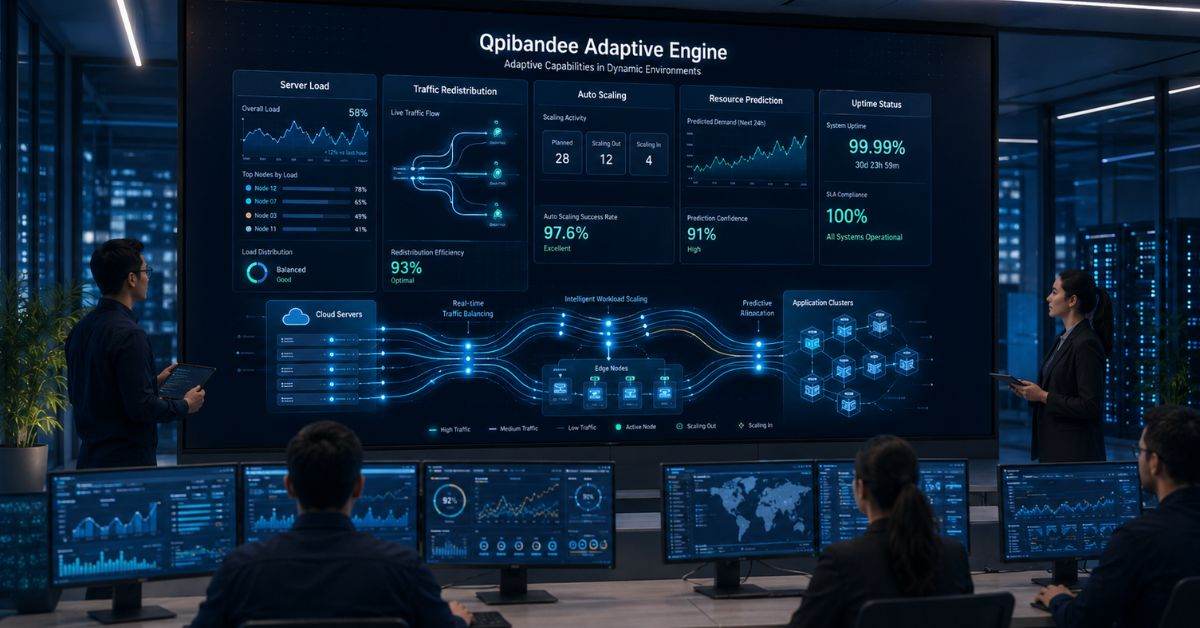
Modern systems must adapt instantly to changes in demand. Whether handling peak online traffic or scaling IoT deployments, adaptability determines system success.
Qpibandee introduces intelligent workload balancing and predictive resource allocation. Instead of reacting after system strain occurs, it anticipates traffic surges using analytics-driven insights.
In e-commerce environments, for example, it dynamically distributes traffic across servers during high-demand periods, ensuring consistent performance and preventing downtime.
Its adaptive capabilities include
- Automated horizontal scaling
- Real-time traffic redistribution
- Predictive resource optimization
- Fault tolerance mechanisms
These features improve uptime, enhance user experience, and reduce operational disruptions.
Real-World Applications of Qpibandee
Qpibandee’s versatility makes it valuable across multiple industries. Organizations implementing it often report measurable efficiency gains.
It facilitates quicker patient data transmission in the healthcare industry by integrating analytics platforms with electronic health record systems. In manufacturing, it connects IoT devices with enterprise systems for predictive maintenance. FinTech companies rely on it to secure API-based financial transactions in real time.
Smart Logistics Transformation
| Metric | Before Qpibandee | After Qpibandee |
| Data Latency | 350 ms | 90 ms |
| Downtime | Frequent | Minimal |
| Integration Costs | High | Reduced by 35% |
By centralizing orchestration and improving communication efficiency, the logistics company enhanced delivery accuracy and operational visibility.
Performance Optimization and Scalability
Performance is a critical metric in distributed systems. It enhances throughput and reduces latency through intelligent caching, edge computing support, and distributed processing.
When feasible, it processes data closer to the source rather than sending it all through a central hub. Response speeds are enhanced and latency is much reduced as a result.
Additionally, it supports both vertical and horizontal scaling. It integrates seamlessly with containerized environments and orchestration tools, allowing businesses to expand operations without service interruptions.
These performance enhancements make it ideal for high-demand applications such as streaming platforms, financial services, and global SaaS environments.
Security and Compliance Framework
Security cannot be an afterthought in interoperable systems. Qpibandee incorporates advanced security protocols into every layer of its architecture.
It uses end-to-end encryption, zero-trust access policies, and multi-factor authentication to protect sensitive data. The framework aligns with globally recognized standards such as ISO/IEC 27001 and NIST cybersecurity guidelines.
Key security strengths include
- AES-256 encryption
- Role-based access control
- Continuous threat monitoring
- Secure API authentication
These measures ensure that interconnected systems remain protected against evolving cyber threats.
Qpibandee vs. Traditional Middleware Solutions
Scalability and modernization are common issues with traditional middleware. It typically requires manual configuration and lacks adaptive intelligence.
Qpibandee, in contrast, operates with automation and real-time orchestration. It eliminates rigid dependencies and supports DevOps workflows.
Organizations transitioning from legacy middleware frequently observe:
- Reduced deployment times
- Improved system flexibility
- Lower maintenance costs
- Enhanced cloud compatibility
This modernization advantage makes Qpibandee a strategic investment for digital-first enterprises.
Implementation Best Practices
Deploying Qpibandee requires careful planning. Organizations should begin with a system compatibility audit and define integration goals clearly.
It is recommended to start with a pilot project, gradually expanding across departments. API-first design principles ensure smoother integration and long-term scalability.
Continuous monitoring and performance evaluation are essential. Collaboration between DevOps teams and cloud architects improves deployment efficiency and reduces risks.
By following structured implementation strategies, organizations can maximize return on investment.
The Future of Qpibandee in Emerging Technologies
As AI, edge computing, and 5G networks continue to evolve, interoperability frameworks will become increasingly important. It is well-positioned to support these advancements.
Future developments may include AI-powered orchestration, quantum-safe encryption, and deeper integration with autonomous systems. Its adaptive architecture ensures it can evolve alongside technological innovations.
By embracing intelligent automation and scalable frameworks like Qpibandee, businesses prepare themselves for long-term digital resilience.
FAQs
Is Qpibandee suitable for multi-cloud environments?
Yes, it is designed to operate across hybrid and multi-cloud infrastructures seamlessly.
Does Qpibandee replace middleware?
In many cases, yes. It offers a more adaptive and scalable alternative to traditional middleware systems.
How does Qpibandee improve performance?
Through intelligent routing, edge processing, and automated scaling.
Is it secure for regulated industries?
Yes, it supports compliance with international security standards.
Can small businesses implement Qpibandee?
Absolutely. Its modular design allows gradual and cost-effective deployment.
Conclusion
Qpibandee represents a next-generation framework for building interoperable, adaptive, and scalable systems. In a world where digital ecosystems are increasingly interconnected, organizations must adopt flexible architectures capable of evolving with technological change.
Through modular design, intelligent orchestration, and strong security integration, it addresses modern integration challenges while delivering measurable performance benefits. From healthcare and manufacturing to finance and logistics, its real-world impact demonstrates its strategic value.
For organizations aiming to modernize infrastructure, improve system communication, and future-proof operations, exploring Qpibandee is a forward-thinking decision. By embracing adaptive interoperability, businesses position themselves for sustained innovation and operational excellence.